
19 October 2026
Published on 2026-10-19
Weight, dimension, and volume metafields now export as a number and a unit, like 12 kg or 1.5 in. Before, the export showed the JSON that Shopify stores, like {"value":12.0,"unit":"kg"}. That works for a computer but it’s harder to read and edit in a spreadsheet.
You can upload the same format back as a spreadsheet edit. The unit isn’t case sensitive and the space is optional, so 12 kg, 12KG, and 12 kilograms all work. You can use short units like cm and lb or full names like centimeters and pounds. The JSON format still works too, so your older spreadsheets import the same as before.
14 October 2026
Published on 2026-10-14
AI search now works in the new design of Bulk Product Editor. You describe the products you want to find in your own words, and the AI sets up the search filters for you.
On the Products page, start typing in the search field. A list opens under the field with two options:
- Search for “…” runs a normal text search. This is what Enter does.
- Find with AI: “…” sends your text to the AI.
Some things you can try:
Read More12 October 2026
Published on 2026-10-12
Shopify now lets you save the packed size of each variant, the length, width, and height of the item when it’s ready to ship. In the Shopify admin it’s the Packed product size row in the Shipping section of a variant. Shopify uses these sizes to pick the smallest of your saved packages that fits an order. You can now bulk edit them with the new Shipping Dimensions field.
You can set the length, width, and height together, or change only one and leave the others blank to keep their current values. You can also increase or decrease a dimension by an amount or a percent. For example, add 2 inches to the width of every variant in a collection. There are also options to convert the dimensions between centimeters and inches, or to remove them. Shopify only supports centimeters and inches for these sizes.
Read More6 October 2026
Published on 2026-10-06
Shopify now lets a variant have up to 20 barcodes, each with an optional type like UPC, EAN, or ISBN. You can now bulk edit all of them, not only the first one.
Pick the new Barcodes (all barcodes, with types) field to add barcodes, add a new primary barcode, remove barcodes, or replace the whole list. Each barcode keeps its type, the same as in the Shopify admin.
Spreadsheets work too. For example, if your books already have a barcode, upload a sheet with a Barcodes: Add column and values like isbn:9780262033848, and the ISBN is added next to the existing barcode. When you match spreadsheet rows or filter products by barcode, the app now checks every barcode on a variant, not only the first one.
5 October 2026
Published on 2026-10-05
You can now change the capitalization of a text field in one step. Pick a field like Title or Vendor in Field to edit, choose Change capitalization in How to edit, and then pick one of these options:
- UPPER CASE:
NIKE AIR MAX RUNNING SHOE - lower case:
nike air max running shoe - Title Case:
Nike Air Max Running Shoe - Sentence case:
Nike air max running shoe
Before, you had to set the field to a dynamic value of the same field and pick a capitalization there. That still works, but when capitalization is the only thing you want to change, the new option is one step.
Read More5 October 2026
Published on 2026-10-05
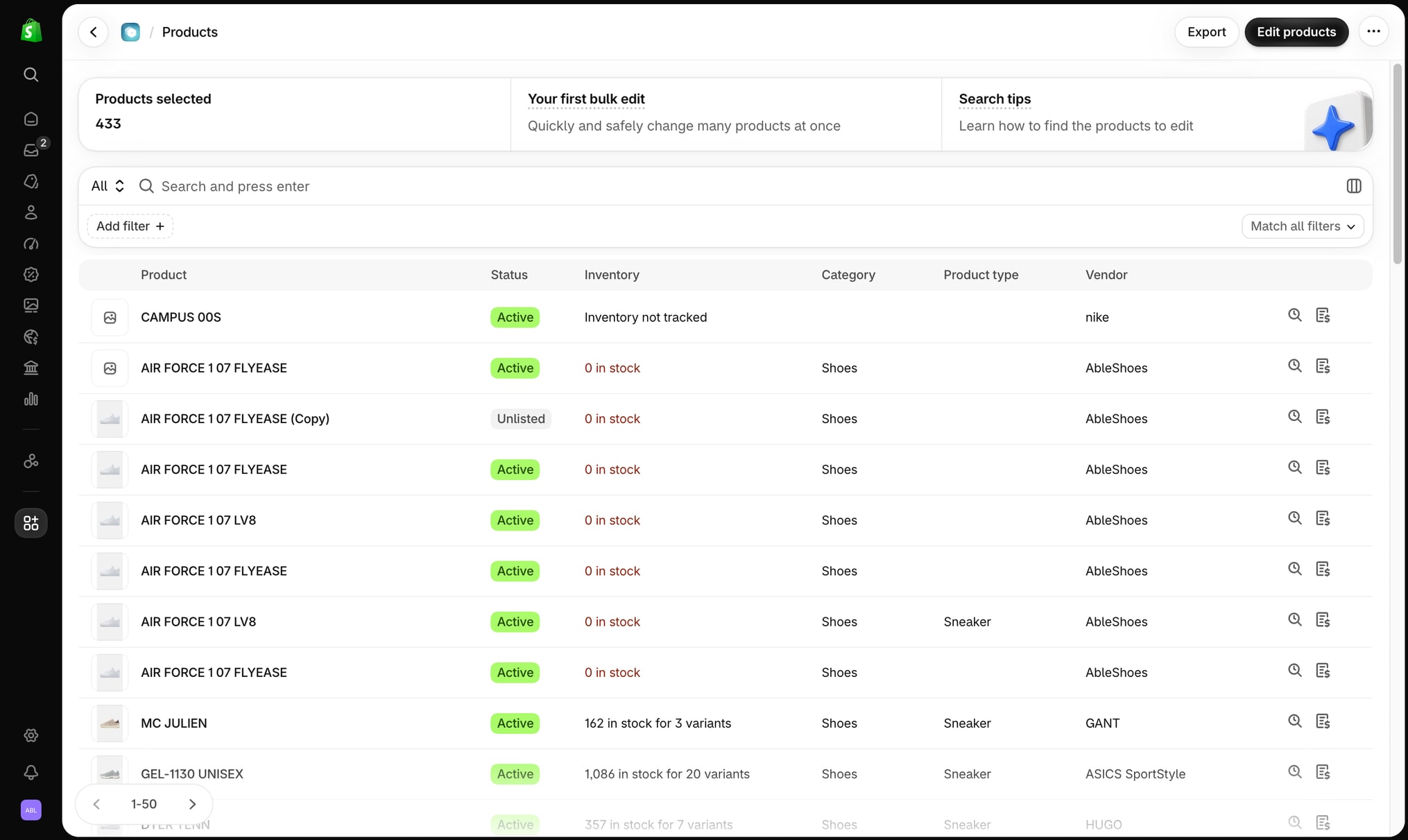
Shopify is gradually rolling out a new design for the admin. We rebuilt Bulk Product Editor to match it, so the app now looks like the rest of your admin, with the same tables, buttons, and page layouts you see on Shopify’s own pages. Edits, spreadsheets, exports, and rules all work the way they did before, and your saved searches, schedules, and history are all still there.
30 September 2026
Published on 2026-09-30
You can now stock or unstock a variant at more than one location from a single spreadsheet cell. In a Stock at this location or Unstock from this location column, put the location IDs in one cell separated by commas (for example, 68080664829, 76277252349) and the variant gets stocked at or unstocked from all of them. Before, the app skipped a cell with more than one ID. IDs that your spreadsheet saved as decimals, like 68080664829.0, work too.
24 September 2026
Published on 2026-09-24
Shopify is changing how shipping is set up. Starting October 1 stores can opt in to market-driven shipping, and Shopify plans to move every store to it by July 2027. With the new setup, shipping rates live on each market instead of in shipping profiles, and a rate applies to all products or to a collection. There’s no way to put a product in a shipping profile anymore, because the profiles are gone.
Read More21 September 2026
Published on 2026-09-21
If you use Shopify Sidekick to set up bulk edits, it can now reach a lot more of the app. Our original version of the Sidekick integration was limited to the most common fields. Now it’s been expanded, so asking it for things like “add the prefix WH- to every SKU from this vendor” or “turn off tax on everything tagged gift-card” works instead of coming back with an error. New fields include SKU, URL handle, option names and values, tax settings, “continue selling when out of stock”, country of origin, HS and tax codes, theme template, weight unit, inventory tracking, and search engine visibility.
Read More18 September 2026
Published on 2026-09-18
We added a new rounding option labeled “Drop decimals”, which sits at the bottom of the rounding list, right after “Keep decimals, rounding down”. It removes the cents from a price without ever rounding up, so $99.99 becomes $99.00 and $75.99 becomes $75.00. A price that is already whole, like $40.00, is left alone. Unlike most of the rounding options, there is no value to specify, so the “to nearest” input is hidden when you pick it.
Read More9 September 2026
Published on 2026-09-09
We’re rolling out a redesigned home page that puts a search box front and center. You can use it to search for a collection, vendor, product type, or tag and go straight to those products with the filter already set.
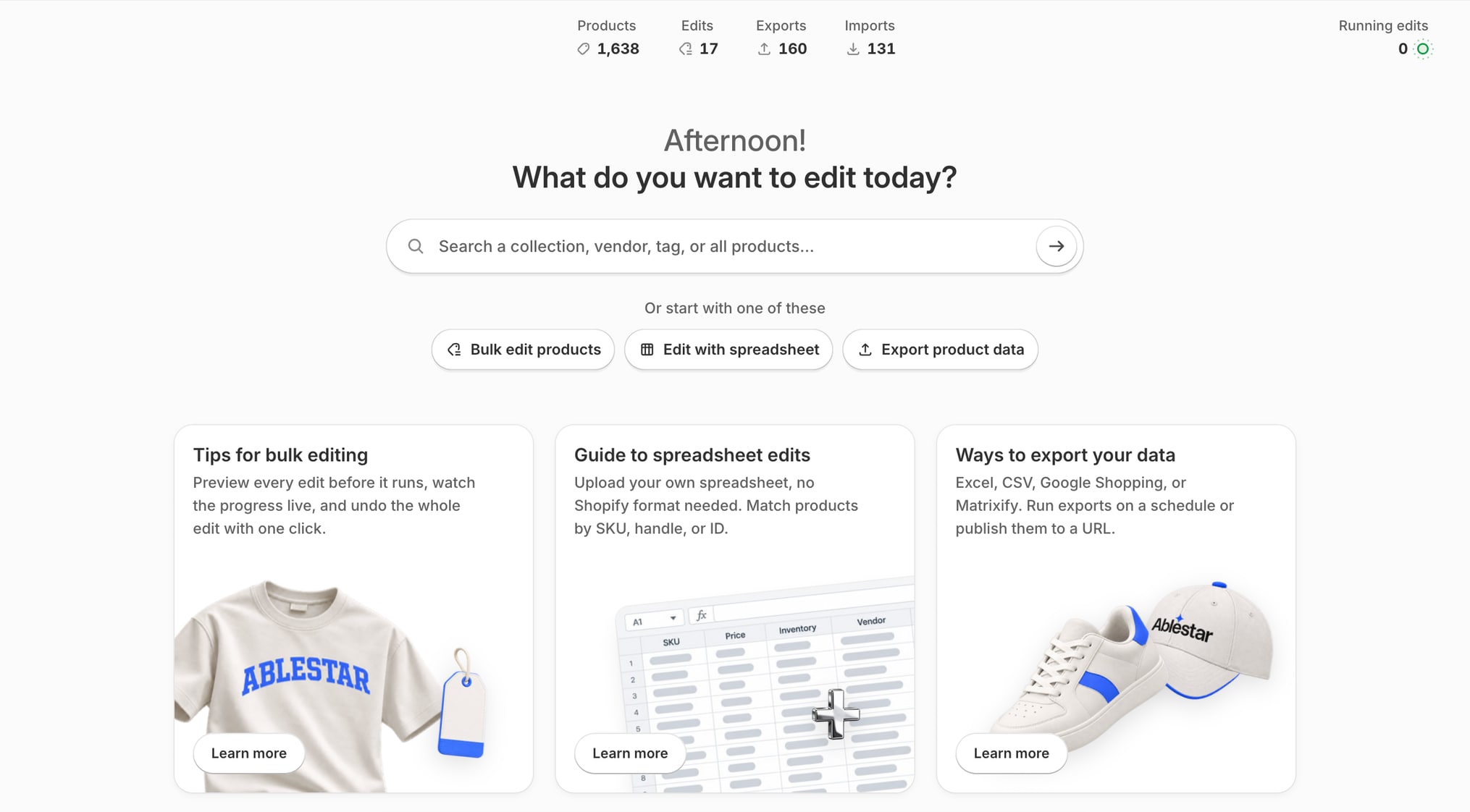
Under the search box are shortcuts for the most common starting points, short guides for bulk editing, spreadsheet edits, and exports, and a “What’s new” card with the latest update from this changelog.
Read More9 September 2026
Published on 2026-09-09
Many fields and edit options now use the same names as the Shopify admin, in edits, filters, and spreadsheet columns, so what you see in Shopify is what you search for in the app.
- Connect Inventory Locations is now Stocked at location, with the options Stock at this location and Unstock from this location.
- Sort Variants is now Reorder variants, next to Reorder product options.
- Images/Media is now Media. The spreadsheet columns are Media: Add images to end, Media: Add images to start, and Media: Replace all images (can’t undo), and the alt text column is Media: Image alt text.
- Visible on Online Store and Visible on Point of Sale are now Published to Online Store and Published to Point of Sale.
- Search/Replace is now Find and replace everywhere it appears.
- The percent options say what they change: Decrease current price by % and Increase current price by %. The option that sets a price from the compare-at price reads Set to % of the Compare-at price and sits right after those two, since that is the usual way to put products on sale.
- Track Quantity/Inventory and Shopify Tracks Inventory are now Track quantity. Continue Selling Inventory when Out of Stock and Inventory Out of Stock Policy are now Continue selling when out of stock.
- Handle (URL) is now URL handle, Type is Product type, Cost is Cost per item, HS Tariff Code is HS code, Is Physical Product is Physical product (requires shipping), and Theme Template is Theme template (products).
- The spreadsheet column Inventory Level is now Inventory Quantity, the same name as the in-app field, and Add Inventory Level is Adjust inventory quantity.
- Spreadsheet columns for collections, descriptions, and tags read Add to collection, Remove from collection, Description: Add to end, Description: Add to start, and Tags: Replace all (overwrites existing).
- There is one Not in any collection filter. Collections no longer have a manual and smart split in the app, so the two filters had become the same thing. Saved rules and recurring edits that use the old filter keep running.
- Per-variant sales channel fields read {channel}, per variant (advanced), and the Settings page for markets is now Catalogs, Markets and B2B.
Nothing changes in how the edits work. Spreadsheets exported under the old column names still map to the right fields when you upload them, and the old names still work as search terms in the field pickers. Repeating and scheduled exports you set up before this update keep their current column headers, so anything reading those files keeps working. New exports use the new names.
Read More7 September 2026
Published on 2026-09-07
Searching for a field in the Field to edit picker, the Add filter menu, and the spreadsheet column mapping is now more natural, so it’s easier to find what you’re looking for. Fields have aliases, so typing “cogs” finds Cost and “stock” finds Connect Inventory Locations. You can also type the start of two words with a space between them: “var me” is enough to reach your variant metafields, and “comp pri” finds Compare-at Price.
Read More1 September 2026
Published on 2026-09-01
You can now move products between shipping profiles in bulk. Shopify’s admin only lets you add products to a profile one search at a time, and there’s no way to say “everything from this vendor” or “everything in this collection”. A lot of you asked for this, so it’s now a normal edit in the app.
To use it, filter for the products you want, add a modification, and pick Shipping Profile under Variant Fields. Then choose the profile the variants should move to. Each variant leaves the profile it’s in now, because a variant can only be in one shipping profile at a time. The preview doesn’t show the current profile (the app reads it from Shopify while the edit runs), but the edit results list the old and new profile for every variant, and undo moves them back.
Read More1 September 2026
Published on 2026-09-01
Edit history and saved searches now show the names of metaobjects, categories, collections, and products instead of their Shopify IDs. The app already showed names for items you had picked during the same session, but if you opened an edit from a link or reloaded the page you’d see values like gid://shopify/Metaobject/12345. The app now looks the names up in the background when the page opens, so you might see the ID for a moment before it changes to the name.
1 September 2026
Published on 2026-09-01
Spreadsheet edits now handle much larger files. A very large upload (tens of thousands of rows with a lot of text in each cell) could get stuck at the configure step and never let you run the edit. We changed how the app stores the contents of big spreadsheets while an edit is set up and run, so files of that size now go through.
There’s nothing to change on your side. Smaller spreadsheets work the same as before, but if you have a large file that failed at the configure step in the past, it’s worth trying again.
Read More19 August 2026
Published on 2026-08-19
If you set different prices for different markets, bulk price edits are now a lot faster. We changed how the app sends price updates to Shopify, and edits that cover many markets finish in a fraction of the time they used to. Large edits that ran for hours now finish in minutes.
There’s nothing to configure. Spreadsheet edits and regular edits both get the improvement automatically, and it applies to market prices and B2B catalog prices alike.
Read More19 August 2026
Published on 2026-08-19
You can now include Unit Price in spreadsheet exports. Unit prices have been editable in the app for a while, but there was no way to get the current values out. The field is in the Variant Fields group on the export page, and it works in the CSV and Excel formats.
Each cell holds the full unit price measurement as a small JSON value, like this:
{"quantityValue": 100.0, "quantityUnit": "G", "referenceValue": 1, "referenceUnit": "KG"}
That’s the quantity in the package and the reference amount the price is shown per. Variants without a unit price export as a blank cell.
Read More17 August 2026
Published on 2026-08-17
Shopify recently added product disclosures. These are things like Prop 65 warnings and choking hazard notices that Shopify shows to buyers on the product page, in the cart, and at checkout. Each disclosure is a metaobject entry (Shopify seeds the standard ones, and you can write your own custom disclosures) and products point to them through the Disclosures metafield (shopify.disclosure).
Bulk Product Editor now treats that metafield like any other metaobject reference. In a bulk edit, pick Disclosures as the field and you get the same options as other metaobject lists: set the value, add to the start or end, or remove entries. The picker searches your store’s disclosure entries by name, so you can select “Proposition 65 Warning for California Consumers” instead of hunting for an ID.
Read More17 August 2026
Published on 2026-08-17
The Tag filter now has two new options: has no tags and has at least one tag.
You could already do this by choosing a tag comparison and picking [EMPTY] from the tag list, but that option only showed up once you started typing so it was difficult to discover. The old way still works and any saved filters/product rules using it are unchanged.